Khairullah Rahim is a contemporary artist based in Singapore. He holds an MFA in Visual Arts from the Mason Gross School of the Arts, Rutgers University (2023), and currently serves as an adjunct lecturer at LASALLE College of the Arts, Singapore.
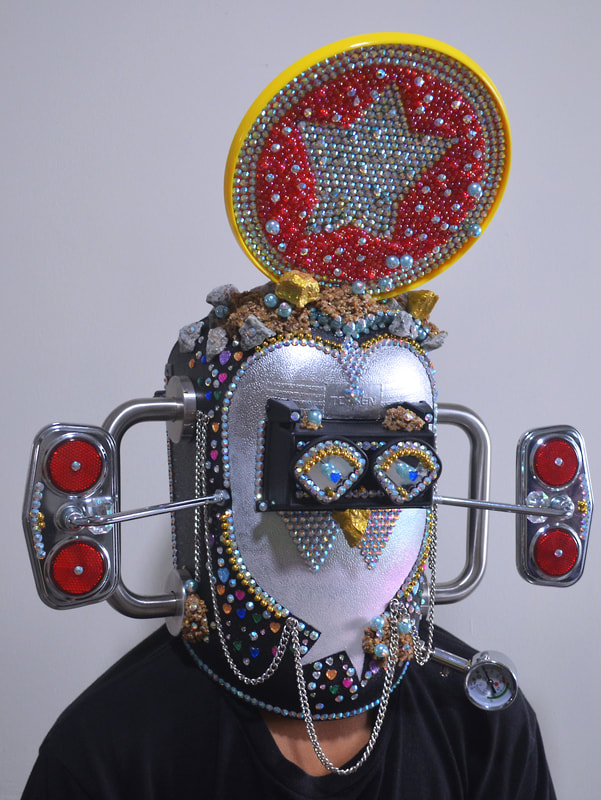
Working across multiple registers of material and form, Khairullah Rahim’s practice examines the entangled relationships between queerness, POZ resilience, working-class subjectivities, and nature. Central to his work is an inquiry into strategies of survival and resourcefulness, particularly within contexts shaped by regimes of surveillance, control, and exclusion. Rather than presenting these themes as fixed identities or singular narratives, Khairullah reframes them within a more imaginative, embodied, and nuanced critical framework. His practice challenges the study and classification of nature, especially within colonial and patriarchal systems, and considers how these have historically intersected with processes of racialisation, gendering, and control. In response, his projects seek to re-inscribe veiled or silenced narratives into public consciousness, addressing how desire, labour, ambition, and resistance are cultivated and sustained within marginalised communities. Material experimentation plays a central role in this process, with a sustained engagement with synthetic polymers and reflective surfaces, particularly rhinestones, which he uses as conceptual tools for camouflage, seduction, and deflection. These materials complicate conventional ideas around visibility and legibility, while also inviting broader questions around safety, survival, artifice, and beauty. In doing so, Khairullah’s work articulates a critical yet affective space where marginality is not only endured but also creatively and defiantly reimagined.
Khairullah has undertaken artist residencies at IASPIS (Stockholm), Goethe-Institut (Singapore), Salzburger Kunstverein (Salzburg), Facebook (Singapore), Hubei Institute of Fine Arts (Hubei), Taipei Artist Village (Taipei), and YOUKOBO Art Residency Programme (Tokyo). His work has been exhibited at institutions such as the Barbican Centre (London), Tai Kwun (Hong Kong), Centre for Contemporary Arts (Glasgow), Tiger Strikes Asteroid (New York), Bangkok Art and Culture Centre (Bangkok), and the National Gallery Singapore, among others. Major projects include the 6th Singapore Biennale, curated by Patrick Flores; Silent Hands, curated by Rotana Shaker, Zain Al Saie, and Jean Wong at Hayy Jameel (Jeddah); and HIV Science as Art, curated by Daniel Cordner and Jessica Whitbread at Brainlab (Munich). Khairullah is the recipient of the IMPART Award for Visual Arts (2017), and his works are held in the permanent collections of the Singapore Art Museum and the SUNPRIDE Foundation.
Working across multiple registers of material and form, Khairullah Rahim’s practice examines the entangled relationships between queerness, POZ resilience, working-class subjectivities, and nature. Central to his work is an inquiry into strategies of survival and resourcefulness, particularly within contexts shaped by regimes of surveillance, control, and exclusion. Rather than presenting these themes as fixed identities or singular narratives, Khairullah reframes them within a more imaginative, embodied, and nuanced critical framework. His practice challenges the study and classification of nature, especially within colonial and patriarchal systems, and considers how these have historically intersected with processes of racialisation, gendering, and control. In response, his projects seek to re-inscribe veiled or silenced narratives into public consciousness, addressing how desire, labour, ambition, and resistance are cultivated and sustained within marginalised communities. Material experimentation plays a central role in this process, with a sustained engagement with synthetic polymers and reflective surfaces, particularly rhinestones, which he uses as conceptual tools for camouflage, seduction, and deflection. These materials complicate conventional ideas around visibility and legibility, while also inviting broader questions around safety, survival, artifice, and beauty. In doing so, Khairullah’s work articulates a critical yet affective space where marginality is not only endured but also creatively and defiantly reimagined.
Khairullah has undertaken artist residencies at IASPIS (Stockholm), Goethe-Institut (Singapore), Salzburger Kunstverein (Salzburg), Facebook (Singapore), Hubei Institute of Fine Arts (Hubei), Taipei Artist Village (Taipei), and YOUKOBO Art Residency Programme (Tokyo). His work has been exhibited at institutions such as the Barbican Centre (London), Tai Kwun (Hong Kong), Centre for Contemporary Arts (Glasgow), Tiger Strikes Asteroid (New York), Bangkok Art and Culture Centre (Bangkok), and the National Gallery Singapore, among others. Major projects include the 6th Singapore Biennale, curated by Patrick Flores; Silent Hands, curated by Rotana Shaker, Zain Al Saie, and Jean Wong at Hayy Jameel (Jeddah); and HIV Science as Art, curated by Daniel Cordner and Jessica Whitbread at Brainlab (Munich). Khairullah is the recipient of the IMPART Award for Visual Arts (2017), and his works are held in the permanent collections of the Singapore Art Museum and the SUNPRIDE Foundation.